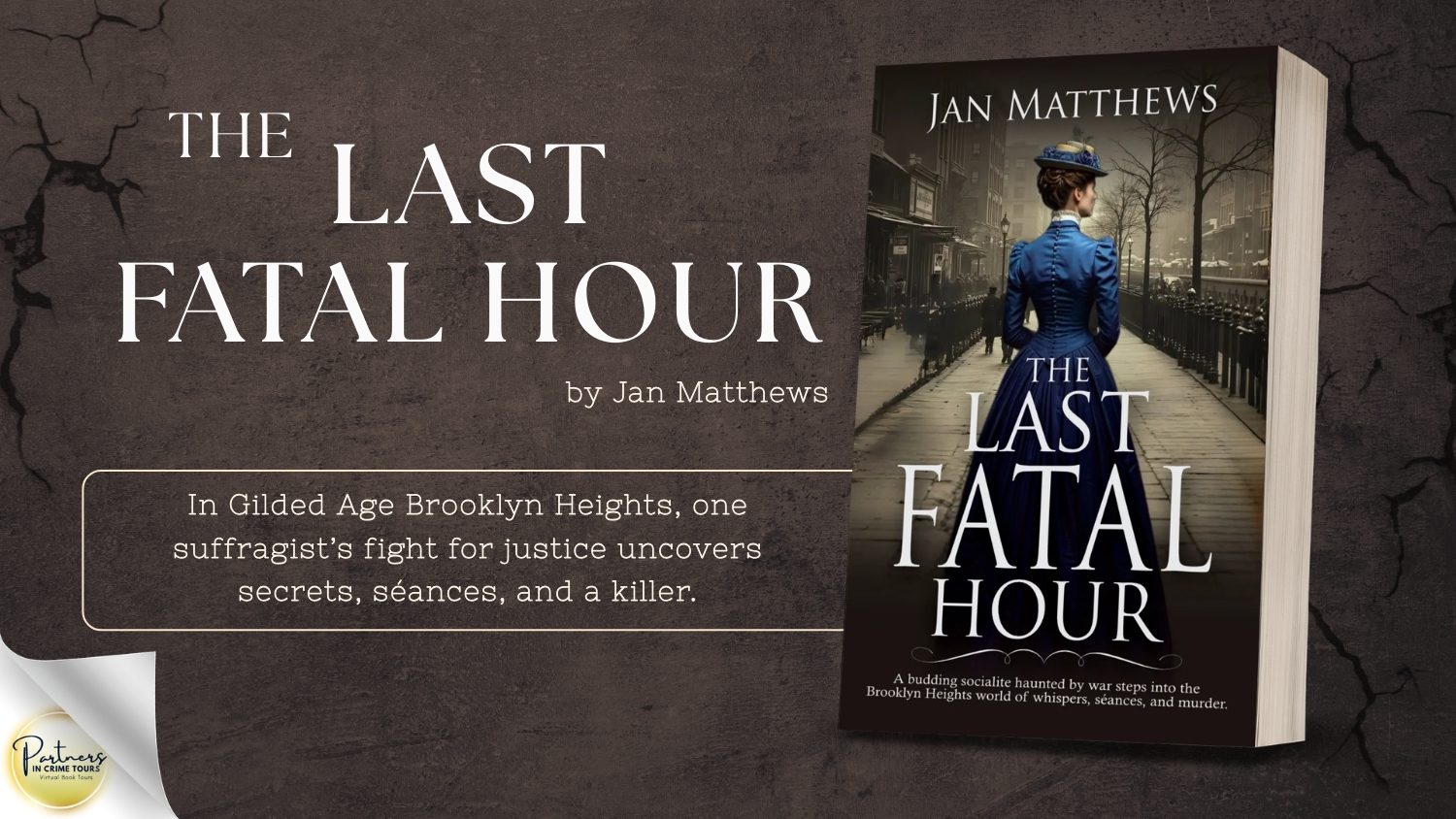
THE LAST FATAL HOUR
by Jan Matthews
May 4 - 29, 2026 Virtual Book Tour
Synopsis:
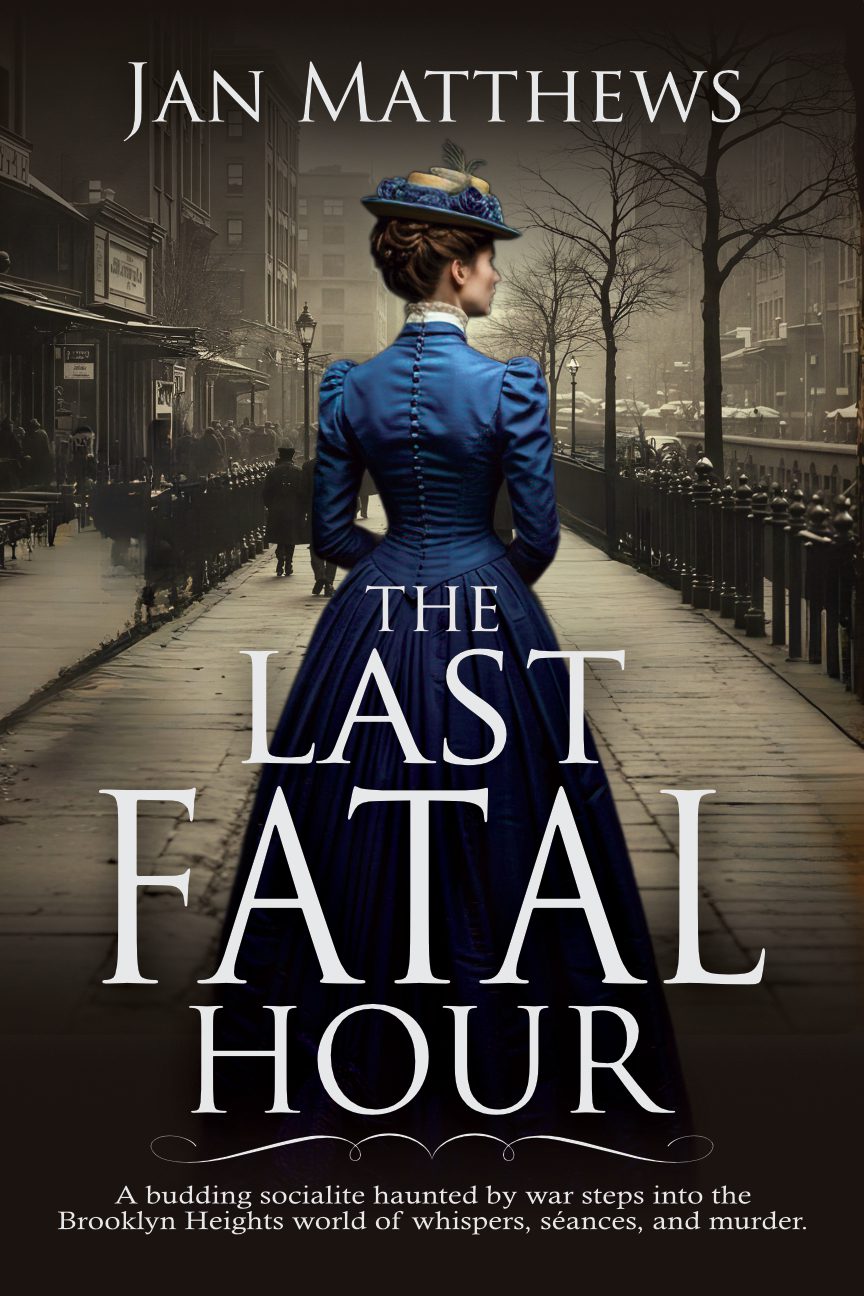
For Leona Gladney, former woman soldier of the Union Army, life goes on despite the echoes of the battlefield in her heart. Now a suffragist and budding socialite in Brooklyn Heights, she yearns for a literary life and family. But her husband’s business partner embezzles their money and disappears.
The society matrons of Brooklyn Heights turn a gimlet eye on Leona after the suspicious death of a wealthy friend. Leona will do anything to find justice for her friend and clear her own name, but she finds only secrets, seances and murder.
Book Details:
Genre: Historical Mystery
Published by: Coffee&ink Press
Publication Date: April 7, 2026
Number of Pages: 320
ISBN: 9798232470982
Book Links: Amazon | Barnes & Noble | BookShop.org | Goodreads
Read an excerpt:
CHAPTER ONE
The blot of ink stuck to her finger, tacky like drying blood. Leona scrubbed at it with her handkerchief as the clock chimed two hours after midnight. She capped the inkwell, and while the ink dried on her most recent entry, she organized the copies with ribbons. Blue for Daphne and red for Ruth. With shaking hands, she slipped the copies into stiff cardboard folios and tied them closed. Sighing, she set them on the desk in front of her.
The flames in the hearth beckoned. This wasn’t the first night she’d yearned for obliteration. It wouldn’t come if she gave in to the urge to throw her labor into the fire. Only paper and ink would vanish, leaving the memories behind.
Pen and ink or back to the laudanum.
A grim thought, the grimmest of all.
The words had clawed their way out tonight. She’d begun the memoir of her time as a Union soldier months ago with the hope her drowning spirits would revive once the words dropped to the page. Yet the foreboding crept through her and tightened around her throat as the little study filled with familiar shadows. This old terror had become a second skin, like the tattered and dirty uniform she’d once worn.
Over the monotonous chatter of the rain, the clock ticked away the seconds until her husband came home. Leona moved to the window, pushed aside the heavy velvet curtains, and looked out at night-shrouded Cranberry Street. A lamp glowed in a window across the street. Homesickness for Boston, for life before the war, for herself before the war, settled on her. The wind threw a heavy splash of rain against the window, and she jumped back, letting go of the curtain.
Pacing the study, her restless thoughts rushed on without fatigue. To keep the memories inside only fed the persistent mental return to the battlefield, and the outpouring of words somewhat tamed her tormented soul. She stopped and touched the folio. Work would save her: work, family, friendship, and love. Maybe she’d write a story about two clocks. A natural clock which kept good time and a mad clock that twisted time out of true.
The street door below opened and closed. At last Gil, home safe. She couldn’t even bring herself to scold him for being so late. Leona listened for his footsteps as she crossed the room to tuck the folios into her desk drawer and locked it. She closed the gaslight apertures in the study and turned up the flame on the wall sconces in the drafty hallway so he could find his way. In the bedroom, she shed her dressing gown, stepped out of her slippers, and kicked them under the bed. Gil made his clumsy climb up the stairs. When he stumbled into the room, she pulled the covers back. He fell into bed fully clothed beside her, mumbling and fretful, the sharp ripe scent of whiskey lacing his breath.
She laid her hand on his shoulder. Beneath the cloth of his shirt, his skin was cold and damp. “Rest now, go to sleep,” she whispered.
***
At first light, Leona had dressed in a blue and cream day gown and made her way downstairs for breakfast. The creeping dread of the night before had waned. She rubbed her gritty eyes and yawned again. Mrs. McCarthy poured coffee from the silver pot, the familiar, civilized table a welcome sight. The scent of bacon made her stomach growl.
“Are you well, m’um?”
Leona glanced into the broad face of their cook and housekeeper, a sturdy and mature woman with a comforting Irish burr. She wore her fading blonde hair in a crown around her head.
“I didn’t sleep much.” Leona yawned again behind her fingers.
Gil’s heavy tread on the stairs made them both jump, and Mrs. McCarthy squeaked.
“I’ll bring more breakfast in a jiffy.” She fled through the side door to the kitchen just as Gil ducked through the hall entrance.
Leona rose and smiled at her husband. He’d made a great effort to come down early after returning so late. She accepted his peck on the cheek, poured him coffee and set it between them, wifely mask in place. He glared with bloodshot eyes at the letter in his hand, and her stomach clenched.
“It’s not all bad news, Gil.” She’d read the contents of the letter before leaving it on his desk in his study, as Grandfather had addressed it to both.
He raised his hazel eyes to her. “You recall Henry has absconded with all our funds?” he asked in a sarcastic tone, squinting at the letter, then back at her.
She no longer knew what to say about Gil’s former business partner, Henry Caldwell-Jones. The police were still looking for him. It put the devil in Gil’s eyes to speak of it, so she tried to let it be, not wanting to distress him even more.
“Of course, I remember, Gil. I—”
“And now your grandfather won’t give me a second loan. I’ll have to go back to the bank and ask them again.”
“He only wants to speak with you face to face about our situation,” she said, in her grandfather’s defense. “He’ll help us, Gil. He did offer to speak at the lyceum on his return from Ohio, to help raise funds. It isn’t as if—” Or was it? “We won’t lose the house, will we?”
The muscles in his lean face twitched as Gil fought to hide his disappointment, and her heart broke a little more to witness it. “Your grandfather does not bring in the interest he once did.”
It was true Leona’s grandfather, poet, abolitionist, and Transcendentalist, didn’t bring in the money he used to at readings in New York and Brooklyn, but he didn’t suffer for it.
Gil raked his fingers through his thick, brown hair and opened his mouth. Mrs. McCarthy entered with his breakfast, apparently stopping what he meant to say next. He reached inside the pocket of his trousers and pulled out a small notebook and pencil. Laying them on the table, his frown deepened.
Once Mrs. McCarthy had bustled out again, Leona said, “I could write to Aunt Louisa.” Who was not truly an aunt, but a friend of her mother’s.
He opened the notebook and touched the tip of his tongue to the pencil. “We cannot afford to feed and house a man of Bronson Alcott’s caliber,” he replied with heaviness. He bent his head to the columns of numbers on the pages.
His confidence and spirits were usually high, and it hurt to see him laid so low. She did mean Louisa Alcott herself, not her father Bronson Alcott, as the speaker for the lyceum to draw a crowd. Her novel, Little Women, published two years before, had become hugely popular.
“I’ll sell the lyceum, that should help,” Gil murmured, eyes downcast.
Leona winced. It was where they’d met nearly a year before. At a loss again, she glanced down at her lapel watch—9 o’clock already. She stood and set cups and plates on the tray.
“Let Mrs. McCarthy do that.” His pencil went on calculating their precarious position.
“I don’t mind. I’m off to see Daphne this morning. I won’t be home until the late afternoon.” Taking a deep breath, she dared to ask, not expecting an answer. “How much do we owe?” She blew out her held breath, apprehension biting at her. “Why won’t you tell me how much Henry has stolen?”
“He’s made me a laughingstock.” His handsome lips formed a tight smile, but he didn’t look at her. “Don’t you worry, Leona, leave it to me. This will all be over by Christmas.”
***
On the street, she began to walk, then turned to observe the window where Gil labored, smoke curling from the chimney. The image stayed with her as she made her way to the newsstand around the corner and waited patiently for her turn to buy a paper. The sunny day, though cold, had driven people outdoors, well wrapped in fur-collared coats and wool scarves. Woodsmoke and the sharp tang of the river mingling with the scent of baking bread drifted on the breeze. She chewed on the frustration that he wouldn’t share their financial details with her. It made her more fearful not to know. Though she kept the memoir and chapter stories a secret from him, this was hardly the same.
Passing the newsstand, an article about the new bridge caught her eye so she bought the latest Brooklyn Eagle. The previous summer, the four of them, Henry, his wife Helen, herself, and Gil, had stood at the end of Noble Street to watch the construction of the giant caissons in the naval yard. Though approval of the bridge was a long-foregone conclusion, the article was typical of the Eagle’s awful anti-consolidation fear mongering. The article repeated the claim linking the boroughs would only bring the dregs of Manhattan’s Lower East Side into Brooklyn’s pure white Heights. The wrongness of such an attitude churned her stomach.
Leona folded the paper and tucked it under her arm with the folio, sighing. Who would save the poor of this world from the hatred of the rich? Her spirits drooped lower.
She breathed deep the November air on familiar, tree-lined Remsen Street, where she’d lived for two years before marrying Gil in August. The red door of the brownstone opened, welcoming her in. Timothy, the butler, took her hat and coat. Before he disappeared with them, his eyes met hers with a familiar blue twinkle.
“I’ll tell her you’re here,” he said.
“Thank you.” She inhaled the sweet smell of hothouse roses set in vases along the long hallway and waited for word of her arrival to reach Daphne and her nurse Audrey.
Audrey approached from the depths of the house. Her eyes, though hooded, were a pure delphinium blue, blonde hair pinned tight to her head. She wore a plain uniform of dark gray with long cuffed sleeves and a white apron.
“Mrs. Van Wyn is in the Lavender Room.” With a curt nod, she turned away.
When they first met, Leona and Audrey had often shared tea and conversation, but of late Leona felt nothing but a wall of smothered animosity between them. They hadn’t argued, as such, though she had an idea where the strained relations came from.
“Is she well?” Leona asked.
For a moment, she didn’t think Audrey would answer, but the woman turned toward her again. “She passed a quiet night. The laudanum helps.”
Leona frowned. Audrey flicked a dismissive hand and went on her way.
The introduction of laudanum in Daphne’s life began not long after Leona moved to Cranberry Street with Gil that summer. The spas and cures Daphne’s grandson Benedict and his wife arranged didn’t seem to help anymore. The family hired Audrey, who administered the laudanum, a common enough panacea. Laudanum’s presence always disturbed Leona, and she had protested to the family, but no one listened. Audrey had become cold after this discussion. Leona believed some of Daphne’s pain came from her daily battle with grief. Leona often feared her own grief and the overuse of laudanum, prescribed by a respected doctor in Boston, had killed the child from her previous marriage to Jack Davenport. Poor dead Jack.
***
Excerpt from The Last Fatal Hour by Jan Matthews. Copyright 2026 by Jan Matthews. Reproduced with permission from Jan Matthews. All rights reserved.
Author Bio:

Jan Matthews is an American expat living in the sunshine in Portugal.
She is (finally) retired from HIM and writes historical mysteries from the Middle Ages to World War I. When not writing or drinking coffee and wine in nearby cafes, she knits and crochets for charity and reviews books on her blog.
Interview:
- When did you first realize you wanted to be a writer?
When I was a kid, like 4th or 5th grade, I knew I wanted to be the mind behind the story.
That’s how I described it to myself at the time, but it was almost like I could peep behind stories and see how they were presented.
- How long does it take you to write a book?
That’s a hard question for me, which I still find kind of amazing, because we live a fairly quiet life, even when I was working. But in the past, when I would write during the day and work at night, the books got done faster (I wrote 4 books and a novella under the pseudonym Heloise West). It took too long to write The Last Fatal Hour, but I wrote and rewrote until it had the shape I wanted. I pulled subplots and added characters who eventually got taken out again. But from when I started it, in 2018 to publication (April 7th 2026) those have been some emotionally turbulent years. I must be one of the few people who didn’t write during the pandemic. I worked at the hospital and drove into the office three days a week, a long commute, overtaken by worry. I made masks from literal scraps and fretted about my mother in assisted living. (She’s ok). Then I worked from home again and got back to writing after work.
- What is your work schedule like when you're writing?
Again, not an easy question! We moved to Portugal in September of 2025 and that took a lot of time and effort (we’d do it again in a heartbeat—we love it here) then we took Portuguese classes and spent some time getting to know the ex-pat community. But I did finish the novel, the finalfinalfinaldraft and started the process of uploading to Draft2Digital, finding reviewers, marketing etc. But. My ideal writing days would be four days a week, 3-4 hours in the morning or afternoon. This is what I’m aiming for when language classes end in a few weeks.
- When did you write your first book and how old were you?
When I was in my late 30s (late 90s) I had the opportunity to go back to college, so I went back full time, though I was working full time. I wanted to be a Medieval History major and to that end, took a medieval history survey class, fall of Rome to around the Black Plague. But it was too much to do both, so I just signed up for a class or two, one of them being a lovely Art of the Crusades course which covered the historical crusades from three standpoints (Christian, Muslim, Jewish) in art, literature, song etc…great class. I came to love Italian Medieval History and wrote a story about a doctor solving murders in 13th century Siena (my favorite European town). I wrote the whole thing through,100,000 words, put it through a critique group, but it was crap, in the end. I do wish I kept it. I purged it, unfortunately. I still love the character and the background, and it is possible to resurrect this character and put him back to work. It was 2010 when I finished it, I think, so I was 50. I wrote some short stories previously and a few got published, but I have never liked writing short stories and don’t find them satisfying to write. I like to read them, I admire the skill, but it’s just not for me.
- How many books have you written? Which is your favorite?
The Last Fatal Hour is my fifth book. I wrote a contemporary gay romantic suspense trilogy starting in 2014, then published a novel called Ardent in 2017, the last for a while. I published with small presses and most of themhave folded. Ardent I am revising, hoping to get it published by the end of the year. I think I’ll revise the novella, too, a historical suspense story set in 18th century Siena.
- Do you have any suggestions to help me become a better writer? If so, what are they?
For me, becoming a better writer meant writing and re-writing. Read the books, take notes on technique, sign up with your genre’s professional groups (RWA, Thriller Writers etc) and join critique groups. Take everything with a grain of salt and keep writing. I’m partial to Save The Cat for structure, KM Weiland for technique. Let your characters talk to you in journals and letters. Writing is a muscle and the more you work it, the stronger it gets.
Catch Up With Jan Matthews:
coffeeandinkbooks.wordpress.com
Amazon Author Profile
Goodreads - @coffeeink
BookBub - @coffeeandink1
Instagram - @coffeeandink197
X - @coffeeandink2
BlueSky - @coffeeandink2.bsky.social
Tour Participants:
Click through the other tour stops for can’t-miss reviews, insider interviews, exclusive guest posts, and more chances to win!Click here to view the Tour Schedule
Enter Before THE LAST FATAL HOUR Strikes...
This giveaway is hosted by Partners in Crime Tours for Jan Matthews. See the widget for entry terms and conditions. Void where prohibited.
THE LAST FATAL HOUR by Jan Matthews || Gift CardsCan't see the giveaway? Click Here!

Very interesting interview. Especially since I will be reading the book myself.
ReplyDeleteThanks so much for sharing!
Thanks for hosting!
ReplyDelete